
Understanding the Four Categories of Phobias
Let’s face it — we are all a bit afraid of something! But phobias are more than ordinary fears. While it is normal to feel nervous around certain animals, heights, medical procedures, or unfamiliar situations, a phobia involves an intense and persistent fear that is out of proportion to the actual danger. This typically leads to complete avoidance of the fear, then interferring with daily life, relationships, work, travel, or medical care.
Phobias Are Commonly Organized Into Four Major Categories
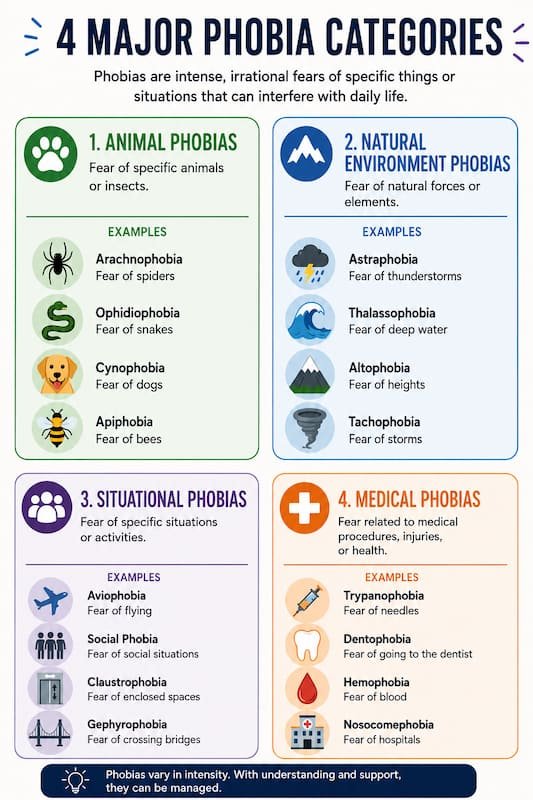
Specific phobias are commonly organized into four major categories: animal phobias, natural environment phobias, situational phobias, and medical phobias. Understanding these categories can help you recognize when fear has become more than a passing concern, so let’s break it down:
1. Animal Phobias
Animal phobias involve an intense fear of specific animals or insects. Common examples include arachnophobia (fear of spiders), cynophobia (fear of dogs), ophidiophobia (fear of snakes), and fears of insects such as bees, wasps, or cockroaches.
Someone with an animal phobia may experience significant anxiety even when the animal poses little or no actual threat. They may avoid parks, basements, outdoor activities, certain homes, or even pictures and videos of the feared animal.
Avoidance can provide temporary relief, but it can also reinforce the fear over time. Exposure therapy can help people gradually face feared animals or related situations in a safe and structured way. Although it feels counterintuitive, avoidance is not helpful long term!
2. Natural Environment Phobias
Natural environment phobias involve fear of situations or conditions found in nature. Common examples include acrophobia (fear of heights), fear of storms, fear of water, and fear of darkness.
For someone with a natural environment phobia, everyday activities can become difficult. A person who fears heights might avoid balconies, bridges, airplanes, hiking trails, or tall buildings. Someone with a fear of storms may constantly monitor the weather or experience significant anxiety whenever rain or thunder is expected.
These fears can sometimes lead to extensive avoidance and reassurance-seeking. Exposure therapy can help individuals learn that they can tolerate anxiety without relying on avoidance or safety behaviors.
3. Situational Phobias
Situational phobias involve intense fear triggered by a particular situation or circumstance. Examples include claustrophobia (fear of enclosed spaces), fear of flying, fear of driving, fear of elevators, and fear of using public transportation.
Situational phobias can be especially disruptive because the feared situations may be difficult to avoid indefinitely. Someone who fears flying may avoid vacations or important family events. A person with claustrophobia may avoid elevators, crowded spaces, MRI machines, or rooms without easy exits.
Fortunately, situational phobias often respond well to exposure-based treatment. Gradual exposure allows individuals to practice staying in feared situations while learning that anxiety can decrease naturally without escaping.
4. Medical Phobias
Medical phobias involve fear related to medical procedures, injuries, blood, needles, or receiving medical care. Examples include fear of needles, fear of blood, fear of injections, and fear of medical or dental procedures.
Medical fears can be challenging because avoiding treatment may have consequences for a person’s physical health. Someone may postpone bloodwork, vaccinations, dental appointments, or other necessary medical care because of overwhelming anxiety.
Treatment for medical phobias include gradual exposure, coping strategies, and education about the body’s response to fear.
When Does a Fear Become a Phobia?
Not every fear requires treatment, but a phobia is more concerning when the fear is persistent, causes significant distress, leads to avoidance, or interferes with important areas of life. You don’t absolutely love your nephew’s new pet snake but you still visit or talking to him about it? Probably just a fear. But, you’ve stopped visiting because of the snake and you begin to sweat just at the thought of being near it? You probably have a phobia.
The good news is that specific phobias are highly treatable. In my practice, I use Cognitive behavioral therapy (CBT), particularly exposure therapy, with my clients to help them overcome their phobia. If fear is keeping you from doing the things that matter to you, you don’t have to continue living around your phobia. Phobia Treatment with Anxiety & OCD Therapy of Maryland can help you build confidence, reduce avoidance, and have more freedom to live everyday life!