Body Dysmorphic Disorder Therapy
online throughout Maryland
Is An Obsession With How You Look Keeping You From Having The Quality Of Life And Relationships You Want?

Have you developed an intense fixation with some aspect of your appearance?
Do you often feel extremely self-conscious, especially when in public or “in the spotlight” of others?
Are you losing countless resources or hours of the day checking, obsessing over, and trying to “fix” the flaw, despite other people telling you there is no flaw that needs fixing?
It’s normal to experience self-consciousness or insecurities about appearance from time to time, but when these concerns become overwhelming to the point that significant symptoms of anxiety, shame, and self-loathing develop, it may be time to consider therapy. These feelings tend to generate very low self-esteem, which only feeds the cycle of distress and obsession even more.
You May Be Struggling With Body Dysmorphic Disorder
Body Dysmorphic Disorder—or BDD—falls under the umbrella of obsessive compulsive-related disorders. Symptoms of BDD are focused on a perceived flaw in appearance, often involving the face or body.
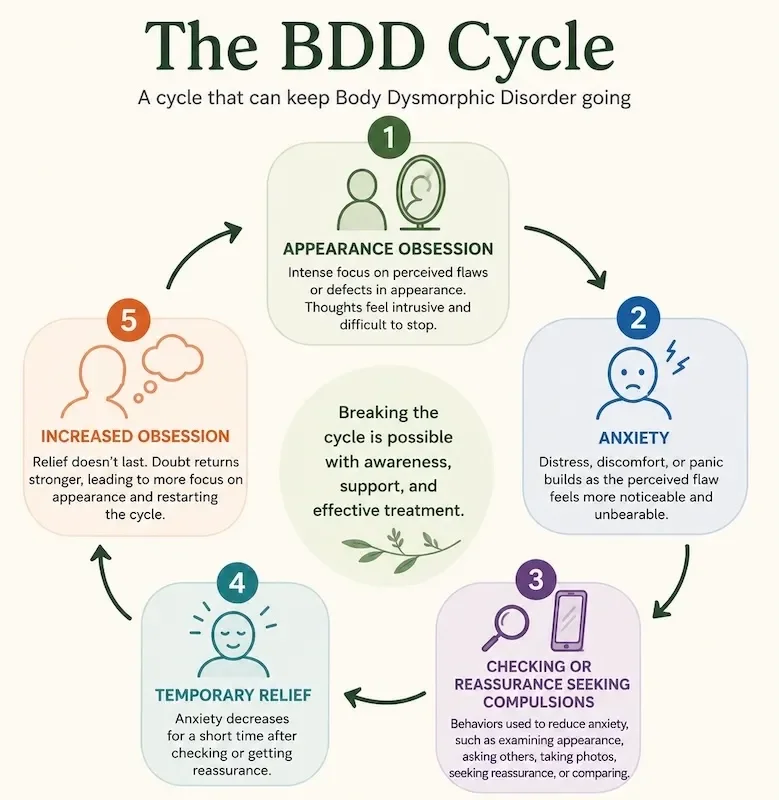
A cycle of obsession and compulsion then develops around this perceived flaw, usually taking the form of “checking” behaviors, avoiding mirrors or spending long periods looking closely at mirrors, or regularly seeking out interventions like dermatology services and cosmetic surgery. “Camouflaging” behaviors are also common, including disguising perceived flaws with makeup, clothing, hats, etc.
BDD affects women and men alike, with women experiencing symptoms at a slightly higher rate. That said, while BDD can involve obsessiveness about any part of the body, Muscle Dysmorphia—or a preoccupation with muscle size that often leads to excessive weightlifting—tends to affect men more.
BDD is not the same as gender dysphoria or an eating disorder. While those issues are important to address in therapy, they are not what my practice specializes in—rather, my treatment specialization is entirely focused on anxiety, OCD, and related issues, including Body Dysmorphic Disorder.
Have a question? Send me a message
BDD Causes The Brain To Focus On Small Details Rather Than “The Big Picture”

BDD is often misunderstood. Although many people think that hyper-fixation on appearance is about ego or vanity, it’s important to remember that Body Dysmorphic Disorder is a verifiable mental health condition related to OCD.
American culture puts so much emphasis on physical appearance, beauty standards, and perfection. When BDD is present, your brain is even more intensely focused on appearance or a specific body part. BDD causes perceptual differences, meaning how you literally see an image of yourself. This is why no matter how many compliments you receive or how much reassurance is offered, you are never convinced that nothing is wrong with your appearance.
Unfortunately, this often results in an anxious, lonely life. Feelings of low self-esteem and a desperate need to hide away may be causing you extreme social anxiety or a fear of being out in public. And over time, you may have noticed increasing difficulty feeling vulnerable, secure, and safe to be intimate in relationships with others.
As an OCD specialist, I understand the suffering that comes with symptoms of Body Dysmorphic Disorder—but I assure you treatment is available. In counseling, you will learn to better understand your body dysmorphia symptoms and the patterns driving them so that you can begin to experience healing, peace, and relief.
Anxiety & OCD Therapy Of Maryland Specializes In Treatment For Body Dysmorphic Disorder
My therapy services are available to clients experiencing obsessive compulsive-related symptoms and patterns, including those associated with BDD.
Whether you struggle with ruminations about how you look or you engage in certain behaviors—such as pursuing “treatments” and compulsively checking or avoiding mirrors—this process is designed to help you create a new relationship with your appearance.

My Approach
The beginning stages of therapy focus on your unique symptoms so that the approach and pace of treatment for BDD can be individualized. In addition to a thorough assessment to better understand your experience, I will use early therapy sessions to educate you about what Body Dysmorphic Disorder is and how it operates.
I understand that the idea of addressing some of your obsessions and behaviors in therapy is intimidating, so I make sure treatment is always paced in a way that prioritizes your comfort level. All of the therapies I use are safe, evidence-based, and particularly effective for treating aspects of OCD and related disorders, including:
Cognitive Behavioral Therapy (CBT), which focuses on identifying and challenging the specific patterns and behaviors involved in your unique experience of BDD.
Perceptual Retraining (also commonly referred to as “mirror retraining”), which seeks to change the brain’s tendency to magnify perceived flaws.
Exposure & Response Prevention (ERP) allows you to safely practice being exposed to your triggers without engaging in your compulsions (i.e., checking the mirror).
Acceptance & Commitment Therapy (CBT) is used to promote mindfulness, acceptance, self-compassion, and living a full, meaningful life.
These interventions are proven to work, offering a gateway to both long- and short-term relief.
There’s A Way Out Of The Cycle
I know it’s probably taken a long road for you to even begin considering treatment for Body Dysmorphic Disorder—in fact, you may have even been in therapy already, only to keep experiencing symptoms. But I focus primarily on these kinds of issues, and I know which combination of approaches can actually work. Through this process, you can begin to suffer less and live more, freeing yourself from the heavy weight of a constant fixation on your appearance.
Frequently Asked Questions About Therapy For Body Dysmorphic Disorder…
I’ve seen many dermatologists and cosmetic providers—why have they never mentioned Body Dysmorphic Disorder?
It’s normal for clients with BDD to seek out the help of dermatologists and cosmetic providers (sometimes many) before ever considering working with a therapist instead. This is often because these types of providers are medical or cosmetic—not psychiatric. They may not fully know how to recognize symptoms of BBD or what the appropriate interventions are.
Body Dysmorphic Disorder is a complex mental health issue related to OCD, which is why it’s important to work with a trained and highly specialized therapist in treatment.
The idea of attending therapy virtually makes me anxious since I know I will have to see myself on the screen—how should I handle this?
I understand that it can be difficult seeing yourself on camera when you struggle with BDD. Your camera probably functions like a mirror in this instance, leading to hyper-fixation, intense self-criticism, avoidance, and other obsessive compulsive-related behaviors… but this is precisely when therapy can be most helpful!
Working at your comfort level, we can use this direct exposure opportunity to learn and practice retraining techniques that you can implement in real time both in and out of the therapy space. This process is safe, and I will be there to support you every step of the way.
Will therapy take a long time to help me manage my BDD symptoms?
Treatment for BDD does require your time and commitment. However, you are likely to see real change begin to occur within 3 to 6 months, while deeper, lasting recovery may take closer to 12 months.
I know this may sound like a long time to someone who is interested in “quick” fixes for perceived flaws, but it’s worth it to learn skills and perspectives that can actually help you overcome urges in a lasting way.
You Don’t Need To Be Fixed
If you feel anxious about, overwhelmed by, or fixated on perceived flaws in your appearance, you may be struggling with Body Dysmorphic Disorder (BDD)—but treatment is available through Anxiety & OCD Therapy of Maryland. Contact me to find out more about how I can help, and I will get back to you within a business day.
Serving clients virtually in Maryland