
How Social Media Can Impact Body Dysmorphic Disorder
Social media has become a major part of everyday life. Platforms built around photos, videos, and appearance can offer connection and community, but they can also create challenges for people struggling with Body Dysmorphic Disorder (BDD). For someone with BDD, social media may intensify preoccupation with perceived flaws, increase comparison, and reinforce behaviors that keep the disorder going.
What Is Body Dysmorphic Disorder?
Body Dysmorphic Disorder is a mental health condition characterized by intense preoccupation with one or more perceived flaws or defects in appearance that are minor or not noticeable to others. Someone with BDD may spend significant amounts of time examining their appearance, comparing themselves with others, seeking reassurance, taking repeated photographs, grooming, camouflaging perceived flaws, or avoiding social situations.
Social media can become another environment where these concerns are triggered and reinforced.
The Impact of Appearance-Based Comparison
One of the biggest ways social media can affect BDD is through comparison. People are constantly exposed to carefully selected images of other people’s faces, bodies, clothing, lifestyles, and experiences. Even when we understand that photographs may be edited, filtered, posed, or carefully curated, it can still be difficult not to compare ourselves.
For someone with BDD, this comparison can become particularly intense. A person might focus on another individual’s skin, nose, hair, body shape, teeth, or facial features and then scrutinize their own appearance for differences. This can increase feelings of inadequacy and make perceived flaws seem even more significant.
Filters, Editing, and Appearance-Focused Content
Filters and photo-editing tools can also contribute to unrealistic expectations about appearance. When altered images become the norm, natural features may begin to feel like imperfections.
Someone experiencing BDD may repeatedly use filters or editing tools to determine how they “should” look. They may become increasingly focused on achieving a particular appearance or checking photographs from different angles. Rather than providing reassurance, these behaviors actually increase doubt and self-consciousness.
Reassurance Seeking and Checking
Social media can also provide new opportunities for reassurance seeking and checking. Someone with BDD might repeatedly post photographs and monitor likes, comments, or reactions to determine whether others think they look attractive.
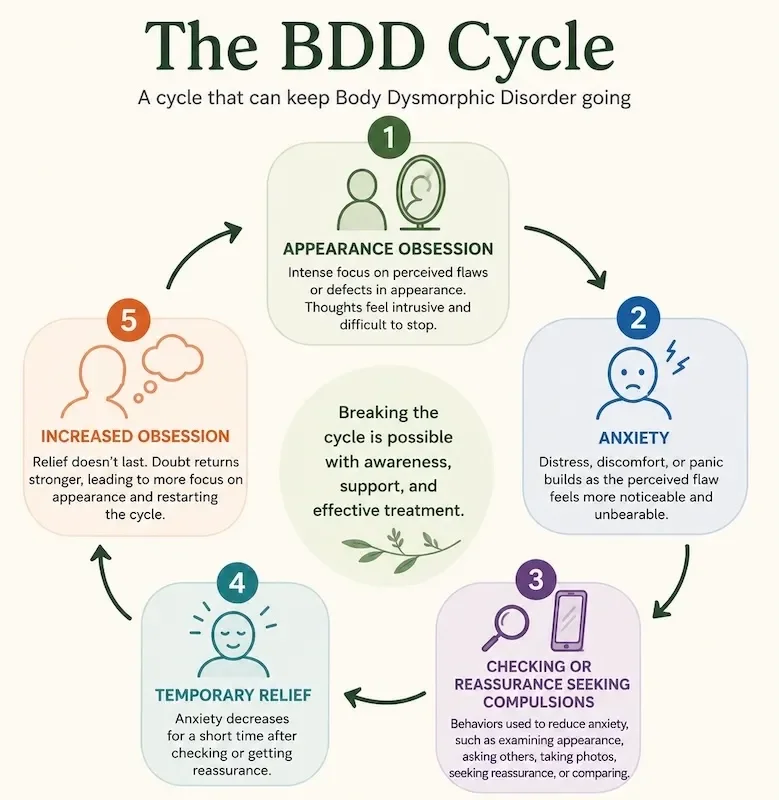
They may also repeatedly check photographs before posting, delete pictures they perceive as unflattering, or ask others for opinions about their appearance. Although these behaviors may temporarily reduce anxiety, the relief often does not last. The person may soon feel compelled to check or seek reassurance again.
This creates a cycle of obsession, anxiety, compulsions of checking or reassurance seeking, temporary relief, and increased obsession.
Behavior of Avoidance
Social media doesn’t always lead to more checking. For some people, it can be the exact opposite — avoidance. A person with BDD may avoid photographs, video calls, dating apps, social events, or posting pictures because they fear being judged.
While avoidance can provide short-term relief, it can make appearance-related fears stronger over time and interfere with relationships, work, and daily life.
Breaking the Cycle
If social media is contributing to BDD symptoms, completely deleting social media isn’t necessarily the answer. Instead, it can be helpful to become more intentional about how social media is used. Consider unfollowing accounts that consistently trigger comparison and following accounts that promote diverse and realistic representations of appearance. Notice urges to check, edit, compare, or seek reassurance without automatically acting on them.
Social media may contribute to the cycle of BDD, but it does not have to control it. With awareness, intentional changes in social media habits, and appropriate treatment, people can begin shifting their attention away from appearance and toward the parts of life that matter most.
Most importantly, treatment can help. Cognitive behavioral therapy (CBT), particularly approaches that include exposure and response prevention (ERP), can help people reduce compulsive checking, reassurance seeking, and avoidance while learning to tolerate uncertainty about their appearance. Anxiety & OCD Therapy of Maryland specializes in obsessive compulsive related disorders, including Body Dysmorphic Disorder therapy.